
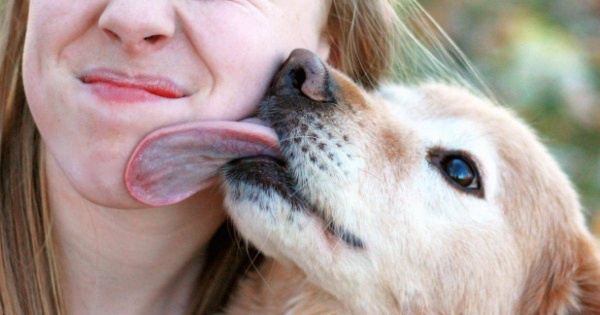
If your dog suddenly walks over, looks at you with those familiar eyes, and starts licking your hand, arm, or face, you might wonder what is going through their mind.
Is it affection?
Are they asking for food?
Do they want attention?
Or are they trying to tell you something?
For many dog owners, licking feels like a canine version of a kiss. And sometimes, it can be part of a friendly or affectionate interaction. But dogs lick people for many different reasons, and the meaning can depend on the situation, the dog’s personality, and what happens immediately before and after the behavior.
Understanding why your dog licks you can give you a better window into their behavior—and sometimes even help you recognize when licking is connected to stress, excitement, or another need.
So, what does it really mean when your dog licks you?
Let’s take a closer look.
Dogs
Use Their Mouths to Explore the World
Dogs experience their surroundings differently from humans.
Their mouths and noses are important tools for gathering information.
When a dog licks you, they may be responding to the taste, smell, texture, and information available on your skin.
Human skin contains sweat and natural oils, and those can have interesting scents and salty flavors that attract dogs.
That’s one reason a dog may become particularly interested in your hands after you’ve been cooking, exercising, or eating.
So while licking can have a social meaning, it can also be a form of exploration.
1. Your Dog May Be Showing Affection
One of the most common explanations is simple:
Your dog enjoys interacting with you.
Dogs form strong social bonds with humans, and licking can occur during friendly interactions.
You may notice your dog licking you when:
- You come home
- You’re sitting together
- You’re petting them

- You’re lying on the couch
- They’re relaxed beside you
If the dog is also showing relaxed body language, a loose posture, a relaxed face, and a comfortable tail position, licking may simply be part of a friendly social interaction.
But it’s important not to assume every lick means exactly the same thing.
2. Your Dog May Want Your Attention
Sometimes a dog learns that licking gets a reaction.
Think about what happens when your dog licks your hand.
You might:
- Pet them
- Talk to them
- Laugh
- Look at them
- Move closer
- Give them attention
From the dog’s perspective, the behavior worked.
They may eventually learn:
“When I lick my human, something interesting happens.”
If your dog consistently licks you when they want attention, the behavior may become part of their communication routine.
Sometimes a dog learns that licking gets a reaction.
Think about what happens when your dog licks your hand.
You might:
- Pet them
- Talk to them
- Laugh
- Look at them
- Move closer
- Give them attention
From the dog’s perspective, the behavior worked.
They may eventually learn:
“When I lick my human, something interesting happens.”
If your dog consistently licks you when they want attention, the behavior may become part of their communication routine.
3. Licking Can Be a Way of Greeting You
Some dogs lick people when they reunite
after being separated.
You may see this when:
- You return from work
- You wake up
- You come home from shopping
- Your dog joins you after being in another room
Excitement can produce many behaviors at once.
A dog may wag its tail, move around quickly, nudge you, jump up, whine, and lick.
In that context, licking may simply be one component of an enthusiastic greeting.
Some dogs lick people when they reunite
after being separated.
You may see this when:
- You return from work
- You wake up
- You come home from shopping
- Your dog joins you after being in another room
Excitement can produce many behaviors at once.
A dog may wag its tail, move around quickly, nudge you, jump up, whine, and lick.
In that context, licking may simply be one component of an enthusiastic greeting.
4. Dogs May Lick Because You Taste Interesting
Sometimes the explanation is much less emotional.
Your skin may simply taste good to your dog.
After exercise, sweat leaves salt and other substances on the skin.
If you’ve recently eaten something, traces of food may also remain on your hands or face.
Dogs have an excellent sense of smell, so even tiny traces of interesting scents can attract their attention.
That’s why some dogs become especially interested in licking:
- Hands
- Fingers
- Faces
- Arms
- Legs
In other
words, your dog may love you—but they may also think you taste interesting.
Sometimes the explanation is much less emotional.
Your skin may simply taste good to your dog.
After exercise, sweat leaves salt and other substances on the skin.
If you’ve recently eaten something, traces of food may also remain on your hands or face.
Dogs have an excellent sense of smell, so even tiny traces of interesting scents can attract their attention.
That’s why some dogs become especially interested in licking:
- Hands
- Fingers
- Faces
- Arms
- Legs
In other
words, your dog may love you—but they may also think you taste interesting.
5. Your Dog May Be Asking for Something
Dogs quickly learn how to communicate with their humans.
A lick might sometimes be followed by another behavior:
Your dog licks your hand, then walks toward the door.
Or they lick you, then stare at their food bowl.
Or they lick you and bring you a toy.
The licking itself may not contain a precise message.
Instead, it may be part of a larger sequence.
Your dog could be communicating:
“Pay attention to me.”
“Let’s go outside.”
“I want to play.”
“I want something.”
Learning to recognize what comes before and after the licking can tell you much more than the lick itself.
Dogs quickly learn how to communicate with their humans.
A lick might sometimes be followed by another behavior:
Your dog licks your hand, then walks toward the door.
Or they lick you, then stare at their food bowl.
Or they lick you and bring you a toy.
The licking itself may not contain a precise message.
Instead, it may be part of a larger sequence.
Your dog could be communicating:
“Pay attention to me.”
“Let’s go outside.”
“I want to play.”
“I want something.”
Learning to recognize what comes before and after the licking can tell you much more than the lick itself.
6. Puppies Learn Social Behaviors Through Licking
Licking begins early in a dog’s life.
Mother dogs lick their puppies as part of normal maternal care.
Puppies
also interact with their mother using behaviors involving the mouth and face.
As dogs mature, licking can remain part of their social repertoire.
This doesn’t mean that an adult dog is literally treating its owner like its mother.
Rather, it shows that licking is a behavior dogs can naturally use during social interactions.
Licking begins early in a dog’s life.
Mother dogs lick their puppies as part of normal maternal care.
Puppies
also interact with their mother using behaviors involving the mouth and face.
As dogs mature, licking can remain part of their social repertoire.
This doesn’t mean that an adult dog is literally treating its owner like its mother.
Rather, it shows that licking is a behavior dogs can naturally use during social interactions.
7. Licking Can Sometimes Be a Calming Signal
This is where things get more interesting.
A dog may lick when it feels uncertain or uncomfortable.
For some dogs, licking can occur alongside behaviors associated with stress or conflict.
For example, a dog may lick its lips or lick a person’s hand when:
- Someone is approaching too quickly
- The dog feels uncomfortable
- It is being restrained
- The environment is unfamiliar
- Another dog is behaving aggressively
- A person is standing over it
In these situations, the licking may not mean:
“I love you.”
It may instead be part of
the dog’s attempt to cope with an uncomfortable situation or communicate that it isn’t looking for conflict.
This is where things get more interesting.
A dog may lick when it feels uncertain or uncomfortable.
For some dogs, licking can occur alongside behaviors associated with stress or conflict.
For example, a dog may lick its lips or lick a person’s hand when:
- Someone is approaching too quickly
- The dog feels uncomfortable
- It is being restrained
- The environment is unfamiliar
- Another dog is behaving aggressively
- A person is standing over it
In these situations, the licking may not mean:
“I love you.”
It may instead be part of
the dog’s attempt to cope with an uncomfortable situation or communicate that it isn’t looking for conflict.
8. Look at the Rest of the Body
This is one of the most important lessons in understanding dog behavior.
Don’t interpret licking by itself.
Look at the whole dog.
This is one of the most important lessons in understanding dog behavior.
Don’t interpret licking by itself.
Look at the whole dog.
Relaxed dog
You might see:
- Loose body
- Soft eyes
- Relaxed ears
- Natural tail movement
- Comfortable posture
Licking in this context may be part of a friendly interaction.
You might see:
- Loose body
- Soft eyes
- Relaxed ears
- Natural tail movement
- Comfortable posture
Licking in this context may be part of a friendly interaction.
Stressed dog
You might notice:
- Lip licking
- Yawning
- Turning the head away
- Avoiding eye contact
- Lowered body posture
- Tucked tail
- Pinned-back ears
- Panting when it isn’t hot
- Repeated attempts to move away
In this context, licking may be associated with stress rather than affection.
You might notice:
- Lip licking
- Yawning
- Turning the head away
- Avoiding eye contact
- Lowered body posture
- Tucked tail
- Pinned-back ears
- Panting when it isn’t hot
- Repeated attempts to move away
In this context, licking may be associated with stress rather than affection.
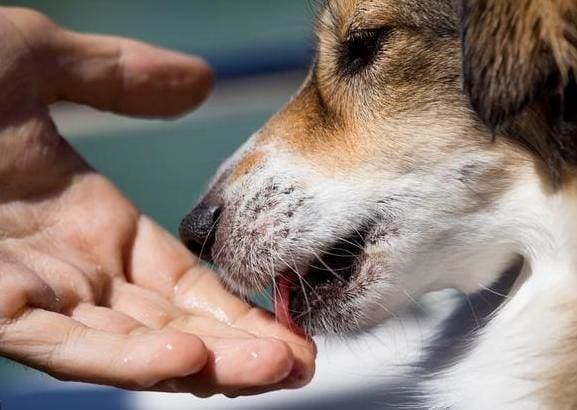
9. Why Does Your Dog Lick Your Face?
Face licking is especially common and often gets interpreted as a canine kiss.
It can be part of social interaction, greeting, attention-seeking,
or exploration.
Your face also contains many interesting scents.
Dogs may be attracted to:
- Food residue
- Sweat
- Skin oils
- Moisture
- Familiar scents
Some dogs simply seem to prefer faces because faces produce a strong social response from humans.
When a dog licks your face, you may laugh or talk to them.
That reaction can reinforce the behavior.
9. Why Does Your Dog Lick Your Face?
Face licking is especially common and often gets interpreted as a canine kiss.
It can be part of social interaction, greeting, attention-seeking,
or exploration.
Your face also contains many interesting scents.
Dogs may be attracted to:
- Food residue
- Sweat
- Skin oils
- Moisture
- Familiar scents
Some dogs simply seem to prefer faces because faces produce a strong social response from humans.
When a dog licks your face, you may laugh or talk to them.
That reaction can reinforce the behavior.
10. Why Does Your Dog Lick Your Hands?
Hands are particularly interesting to dogs.
Think about everything your hands touch during the day.
Food.
Objects.
Other animals.
Outdoor surfaces.
Cleaning products.
Furniture.
Your own skin.
Your hands carry a huge variety of smells.
For a dog, licking your hand can therefore be a way of gathering information.
If your dog starts licking your hands after you’ve been preparing food, the explanation may be especially simple:
They smell something interesting.
Hands are particularly interesting to dogs.
Think about everything your hands touch during the day.
Food.
Objects.
Other animals.
Outdoor surfaces.
Cleaning products.
Furniture.
Your own skin.
Your hands carry a huge variety of smells.
For a dog, licking your hand can therefore be a way of gathering information.
If your dog starts licking your hands after you’ve been preparing food, the explanation may be especially simple:
They smell something interesting.
11. Why Does Your Dog Lick Your Feet?
Feet can be another favorite target.
or exploration.
Your face also contains many interesting scents.
Dogs may be attracted to:
- Food residue
- Sweat
- Skin oils
- Moisture
- Familiar scents
Some dogs simply seem to prefer faces because faces produce a strong social response from humans.
When a dog licks your face, you may laugh or talk to them.
That reaction can reinforce the behavior.
Feet can be another favorite target.
or exploration.
Your face also contains many interesting scents.
Dogs may be attracted to:
- Food residue
- Sweat
- Skin oils
- Moisture
- Familiar scents
Some dogs simply seem to prefer faces because faces produce a strong social response from humans.
When a dog licks your face, you may laugh or talk to them.
That reaction can reinforce the behavior.
10. Why Does Your Dog Lick Your Hands?
Hands are particularly interesting to dogs.
Think about everything your hands touch during the day.
Food.
Objects.
Other animals.
Outdoor surfaces.
Cleaning products.
Furniture.
Your own skin.
Your hands carry a huge variety of smells.
For a dog, licking your hand can therefore be a way of gathering information.
If your dog starts licking your hands after you’ve been preparing food, the explanation may be especially simple:
They smell something interesting.
Hands are particularly interesting to dogs.
Think about everything your hands touch during the day.
Food.
Objects.
Other animals.
Outdoor surfaces.
Cleaning products.
Furniture.
Your own skin.
Your hands carry a huge variety of smells.
For a dog, licking your hand can therefore be a way of gathering information.
If your dog starts licking your hands after you’ve been preparing food, the explanation may be especially simple:
They smell something interesting.
11. Why Does Your Dog Lick Your Feet?
Feet can be another favorite target.
Feet can be another favorite target.
When You Cry?
Dogs can be very responsive to changes in human behavior.
When you’re crying, your facial expressions, posture, breathing, vocalizations, and behavior all change.
Some dogs respond by approaching, staying close, nudging, or licking.
It can look like they’re saying:
“Are you okay?”
We should be cautious about assuming exactly what a dog understands emotionally.
But dogs are certainly capable of noticing changes in human behavior and responding to them.
So if your dog becomes unusually attentive when you’re upset, their behavior may reflect sensitivity to your changed emotional state.
Dogs can be very responsive to changes in human behavior.
When you’re crying, your facial expressions, posture, breathing, vocalizations, and behavior all change.
Some dogs respond by approaching, staying close, nudging, or licking.
It can look like they’re saying:
“Are you okay?”
We should be cautious about assuming exactly what a dog understands emotionally.
But dogs are certainly capable of noticing changes in human behavior and responding to them.
So if your dog becomes unusually attentive when you’re upset, their behavior may reflect sensitivity to your changed emotional state.
14. Why Does Your Dog Lick You Then Walk Away?
This can be surprisingly common.
Your dog may give you a quick lick and then leave.
That doesn’t necessarily mean anything dramatic.
The lick could have been:
- A greeting
- A brief social interaction
- Attention-seeking
- A response to your movement
- Exploration
Dogs don’t necessarily have to remain beside you
This can be surprisingly common.
Your dog may give you a quick lick and then leave.
That doesn’t necessarily mean anything dramatic.
The lick could have been:
- A greeting
- A brief social interaction
- Attention-seeking
- A response to your movement
- Exploration
Dogs don’t necessarily have to remain beside you
Comments
Post a Comment